Events

Showing posts with label Digital Humanities. Show all posts

Friday, November 30, 2012

New Leaders at Hampshire College Library: Library Director Jennifer Gunter King and Archivist Jimi Jones


Good news really deserves full and proper coverage, but since I am (for a variety of reasons) unable to give it that at the moment, I'll take solace in the fact that it also speaks for itself:

In the interval since my first mention of our library search, Hampshire College has made not one, but two outstanding hires, the first for the position of Director of the Library, the second for College Archivist. I was a member of the search committee for the former and attended the candidate talks and offered feedback for the latter. As it happens, I was personally acquainted with the successful candidate in the former and was familiar with the work of the latter. I could not be happier.


Welcome, Jennifer Gunter King and Jimi Jones!

Our new Library Director is Jennifer Gunter King, whom I have known for five years, since we worked together on the "Bookmarks" events of Museums 10, the consortium of Pioneer Valley Museums. Arranging book-related exhibitions and programs engaging institutions from the Emily Dickinson Museum (obvious) and Five College art museums (logical enough) to the Amherst College geological museum (now, that was a tough one) was no mean trick, and it is no understatement to say that Jennifer's energy and creativity were a driving force behind the series, its intellectual conception, and its success. (program site here; I posted a few brief descriptive reports on the first half of the program here; Roger Mummert of the New York Times wrote about the exhibition and the general book culture of the area: "In the Valley of the Literate.")

Jennifer, until now head of Archives and Special Collections at Mount Holyoke College, has many talents. Trained to work in traditional rare print and manuscript sources, she is also passionately committed to doing the work of the present using the tools of the present, and geared to the distinctive needs of Hampshire College. For example, given that we do not have traditional "special collections" involving internationally famous rarities, and rather, documents mostly associated with the personae or general mission and values of the young college, she sees the need to highlight student and faculty work, to digitize and publicize our current cultural production.

I'll let her explain her approach herself in this profile, published at the time of her hiring in March. Among other things, it said, "At Hampshire, she believes it is essential to showcase the intellectual output of the Hampshire community past and present. Because of the preponderance of work done in new media, King wants to make sure that, from an archival and research perspective, work isn’t lost due to a lack of ability to preserve and showcase those materials."

This philosophy meshes perfectly with that of our new archivist, Jimi Jones. He comes to us fresh from a prestigious position at the Library of Congress, with equally impressive credentials and an equal commitment to both cutting-edge practices and the distinctive mission of the College. Although I had not met Jimi before his campus visit, I was familiar with his regular blog posts on "The Signal," the digital preservation blog of the Library of Congress. What impressed me was not just his expertise in these specialized (though today becoming the norm) areas, but also his historical perspective and breadth of vision. Like Jennifer, he understands the role of digital media.

Like Jennifer, he also has multiple talents and varied interests, extending, for example, to art, and in particular, the book arts, with which he was involved at the University of Utah. Book arts, perhaps because students have a new appreciation for the physical and the tangible in an increasingly "virtual" age, have become very popular since we founded the Center for the Book here at the end of the last century (sorry, can't help myself: just like to use that phrase). The two worlds came together recently just around the time of Jimi's arrival with our very successful "Pulp to Pixels" program and exhibit (blog here), funded by a Five College Mellon grant for digital humanities. Jimi hit the ground running, and his energy, approach, and talents can be appreciated from this report, which he posted on our Hampshire Media Tumblr.

Not only do these hires bring to us two talented leaders of their respective departments or domains. They will also be a wonderful stimulus to all aspects of our Center for the Book, which understands "the history of the book" as the study of the technologized word, thus embracing the entire sweep of development from the origins of writing to today's "new" media.

Obviously, great hires such as these are good for the College in a direct and practical sense. More generally and perhaps more important, though, the decision of these two highly qualified professionals to come here when they could be highly competitive and sought-after candidates anywhere, is a real vote of confidence for the accomplishments and prospects of the institution. These days, Hampshire College, under the leadership of new President Jonathan Lash, is feeling a new sense of energy and collective purpose as it continues to fulfill its mission of preparing students to learn and live in an ever more complex world in which the liberal arts must retain their value even as the nature of knowledge and information are changing at an unprecedented pace.

Friday, August 12, 2011

Walking the Walk and Tweeting the Talk


According to a new survey released this week, web search engines and email are the most popular forms of digital media among the US adult population: some 92 percent of us use them, 60 percent of us, daily. Nearly half of us use social networking sites (SNS), such as Facebook. What is interesting is not just the increase in overall use of SNS (nearly doubled from 2008 to 2010), but also the changing demographic: both older and more gender-balanced. The average age of the social network site user has risen from 33 to 38, with half over 35. And, at 56 percent, women's participation now slightly outnumbers that of men. However, only 13 percent of us are on Twitter (though world-wide, we are 200-million strong).

Is Twitter, as so many acquaintances dismissively say, a faddish and foolish exercise in narcissism—a sort of metaphorical modern mashup of the twentieth-century "pet rock" and vanity license plate—or, as others maintain, a valuable social, intellectual, and marketing tool?  As an inveterate tweeter, I of course incline toward the latter opinion. The usage statistic alone, absent more granular data, could support either view. If it's a fad, though, it's certainly restricted to a relatively small population, but which: the proverbial "early adapters"? (if so, what is the profile?) gen-Xers? And just how do they use it? One of my "tweeps" (to you non-users: a Twitter friend, someone I "follow" or who "follows" me) perfectly summarized the competing views last month in a nice little blogpost entitled, "How to Use Twitter (and Why It’s Not a Waste of Time." There, she lovingly and originally characterized Twitter as: "the semi-colon of social media – people have an idea of your existence but many have not fully grasped your usefulness and beauty."

We are only beginning to study the significance of new social media, and Twitter is arguably the least-studied and least-understood among them. To be sure, there have been some rather silly pieces about use of Twitter in the classroom (spare me, please; I'd be happy if my students used spellcheck intelligently), but relatively few rigorous studies of its real value in the academic and cultural sphere, proper. I hope to address that question eventually. In the meantime, I instead wanted to do something much more modest, namely: share one example of how my colleagues and I recently employed Twitter for both academic and social purposes.

As I mentioned in my brief post on the SHARP conference on the book in art and science, social media are coming to play an increasingly important role in our gatherings, and not just in a trivial or recreational way. Last year, in Helsinki, we made full use of a variety of media. For example, we live-streamed some of the main events, such as keynotes and plenaries. Most novel, however, was our use of Twitter. Several of us began to tweet coverage of the events, simply because we tweet all the time. Several people who could not attend said that this coverage not only allowed them to experience the events from a distance, but even inspired them to join the organization. We could not have hoped for a more encouraging result.

This year, as an experiment, we decided to make tweeting an official activity. Many officers on the Executive Council—the President, Vice President, Treasurer ("That, uh, that, that would be me," as Bob Newhart used to say), Recording Secretary, and Membership Secretary—are already individually active (to varying degrees) on Twitter, and there is in addition a general SHARP Twitter account as well as a special one for this conference. "Official" here meant: explicitly endorsed and encouraged from above. In order to lend some material incentive to that moral exhortation, we even offered a prize—in the form of copies of the winner of the annual Book Award—to the ten top tweeters. (Among other things, that meant putting our money where our mouth was—and your Treasurer, I can assure you, does not disburse your funds lightly). We generated over 2000 tweets, archived here.

There were many pleasures, chief among them, the rewarding feeling of belonging to a community within a community (which is to say, as far as I was concerned, a more intimate alliance rather than any form of snobbery), and the excitement at the prospect of finally meeting at the conference, or at a separate "tweet-up" after hours, face to face, people whom one knew only by their usernames, and via 140-character snippets of conversation.

In the course of our (real-life as well as virtual) conversations, SHARP Board member George Williams, by day a professor of English at the University of South Carolina Upstate, who at night dons the cape and tights of heroic editor of the "ProfHacker" blog on at the Chronicle of Higher Education, asked the more active tweeters to write up brief reflections on their use of this social networking tool at the conference for his column.

Here's the beginning of my contribution:
To tweet or not to tweet? If I do not tweet for myself, who will tweet for me? If I tweet only for myself, what am I? Twitter, as one of my non-SHARP “tweeps” says, is the most misunderstood of social media. To wary outsiders, for whom it represents an exercise in egotism, I gently explain that it all depends on what you are looking for and whom you choose to follow. In the 4 years I’ve been on Twitter, it has become one of my most valuable research and networking tools. Frankly, I am much more interested in what total strangers on Twitter are reading than what my Facebook friends had for lunch or their kids did at the birthday party. . . .
George's introduction and the rest of the individual contributions can be found here.

What do you think? Comments welcome.

New Director at the Jones Library

From: To Find the Principles


 On Tuesday evening (August 9), the Trustees of the Jones Library selected Sharon Sharry, of the Greenfield Library to become the new Director of our public library.

I've been covering the search over on the main and history blog site, simply because that's where most other Jones Library coverage has been, given that it has involved primarily historic preservation and local politics.

It's an exciting and welcome development: staff and residents are energized and inspired, and one can only wish Ms. Sharry all possible luck and success. She can lead the Jones knowing that the town is behind her.

Here are links to the main recent posts:

Here Today, Gone Tomorrow
Update: New Director at the Jones Library (and some advice on new media needs)
Initial report on the choice of Sharon Sharry as Director
Report on candidate presentation by Sharon Sharry
Report on candidate presentation by Christopher Lindquist


Thursday, August 11, 2011

Back From DC With a Sharpened Appetite for Bookish Matters


It's now been about two weeks since I returned from the annual conference of the Society for the History of Authorship, Reading and Publishing (SHARP) in Washington, DC—feeling, as always—as one of my tweeps put it—"post-conf malaise mixd w/urge to wrk," "so grand that I was sad to leave that collegiality."

This year's theme was science, art, and the history of the book, though, as always, conference papers and panels were not restricted to that theme. One of the best panels I attended had nothing to do with any of that and was right up my alley: it dealt with the book trade in the Third Reich. Incidentally, it took place in the first session of the first day, an auspicious start. I won't attempt to report on the conference here for the moment, instead simply hoping to act on that sense of collegiality, inspiration, and "urge to work" by posting here more frequently now on various topics related to the history of the book. I'm afraid that even trying to keep up with the historical and historic-preservation topics on the "home blog"—To Find the Principles—has been almost more than I can manage these days.

In the meantime, a few scenes from the conference.
The Executive Council (EC) at work: President Leslie Howsam in the center, Vice President Ian Gadd, at left.

Key topics included finances (they are sound, and we agreed not to raise membership fees this year); future conference sites (2012: Dublin; 2013: Philadelphia); adapting our listserve to the newer needs and standards of the current digital culture; new initiatives to support student participation and general scholarly research, and the continuing internationalization of the organization.


Among the firsts for this EC meeting: remote participation. Director of Publications and Awards Claire Squires, just returned from a conference in Tübingen, "Skyped in" from to her home base at the University of Stirling, where she is Director of the Stirling Centre for International Publishing and Communication.

The officers have done business by Skype on several occasions, just not at an EC meeting. The real first, however: first cat to attend an EC meeting, and from Scotland, via Skype. Now that's progress.


The EC meeting took place in the elegant quarters of the Corcoran Gallery and School of Art + Design, one of the conference hosts, and site of pre-conference program activities.


In the atrium:  "Painting Big": works by Chris Martin. (Ever wonder how they manipulate and mount such mammoth works? Videos on the website explain that, too.)


Conference registration at the National Library of Medicine in Bethesda, MD, also the site of the opening keynote and welcome reception.  Security was extremely tight here because the Library is located on the campus of the National Institutes of Health), so we had to allow additional time for visitors to travel by metro, pass through checkpoints, obtain ID badges, and so forth.

One of the distinctive features of this conference was the co-hosting by multiple organizations. Although most SHARP conferences hold events at multiple sites, there is generally a principal institutional sponsor and venue—often, for example, a university or major library. This year's conference, meticulously organized by SHARP Membership Secretary Eleanor Shevlin and Casey Smith, Interim Chair of the Arts and Humanities at the Corcoran, was a logistical triumph as well as a great intellectual success. Despite the need to move large numbers of people back and forth between venues—many of which, this being DC, involved security checkpoints—there were no disasters or even delays. Movement


Eleanor Shevlin introduces Jonathan Topham (Senior Lecturer in the History of Science, University of Lees), who delivered the keynote lecture, "Why the History of Science Matters to Book History."


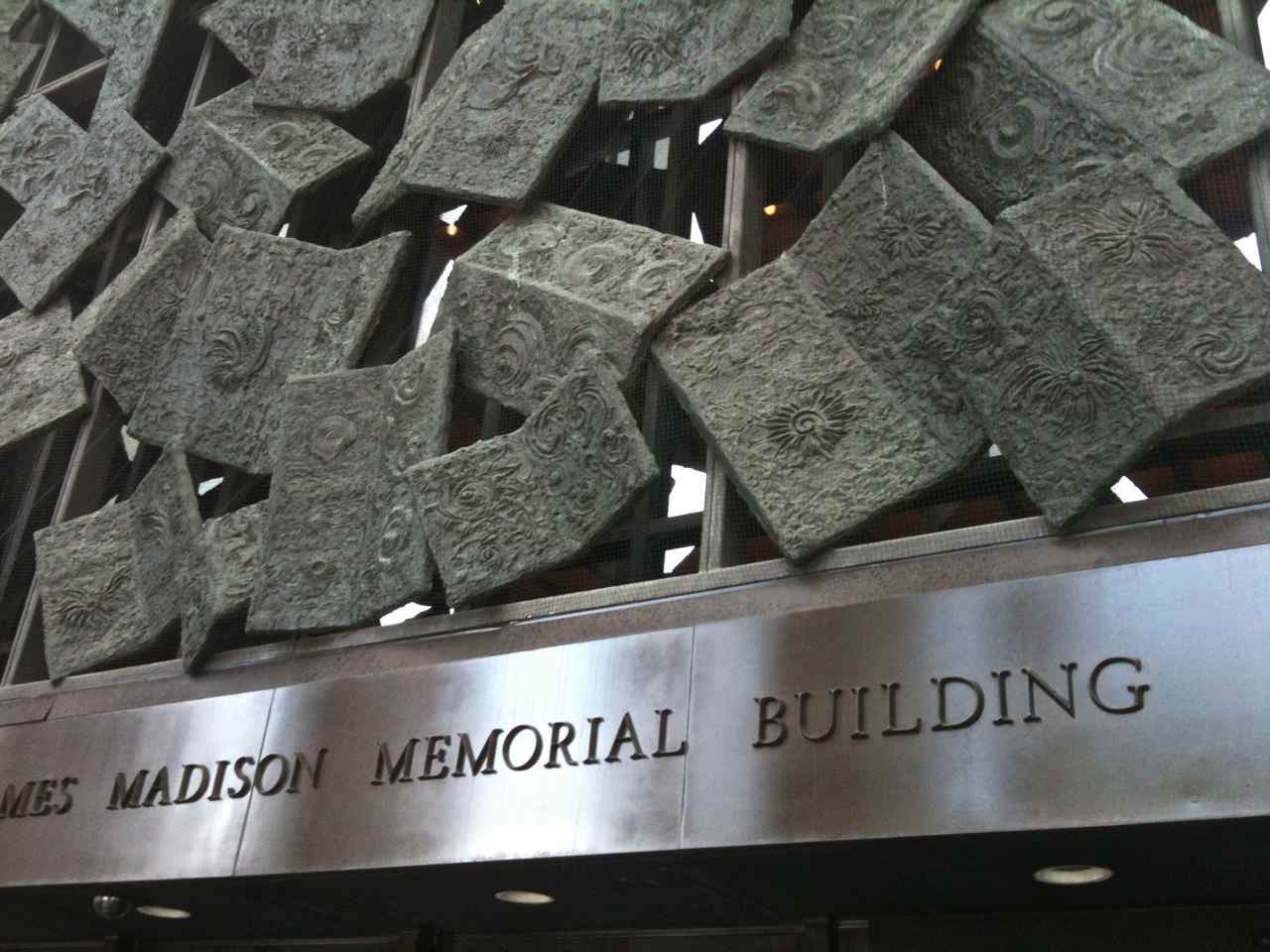
The first full day of sessions took place at the Library of Congress.


Welcome, but let's see what's in your pockets and that bag. Security checks even at a library: the contemporary world.

I didn't blog during the conference, and I probably won't write in detail about most of the proceedings. However, we did cover the proceedings live via Twitter, and with great success. More on that in the next post.