Events

Showing posts with label Book History. Show all posts

Tuesday, March 24, 2015

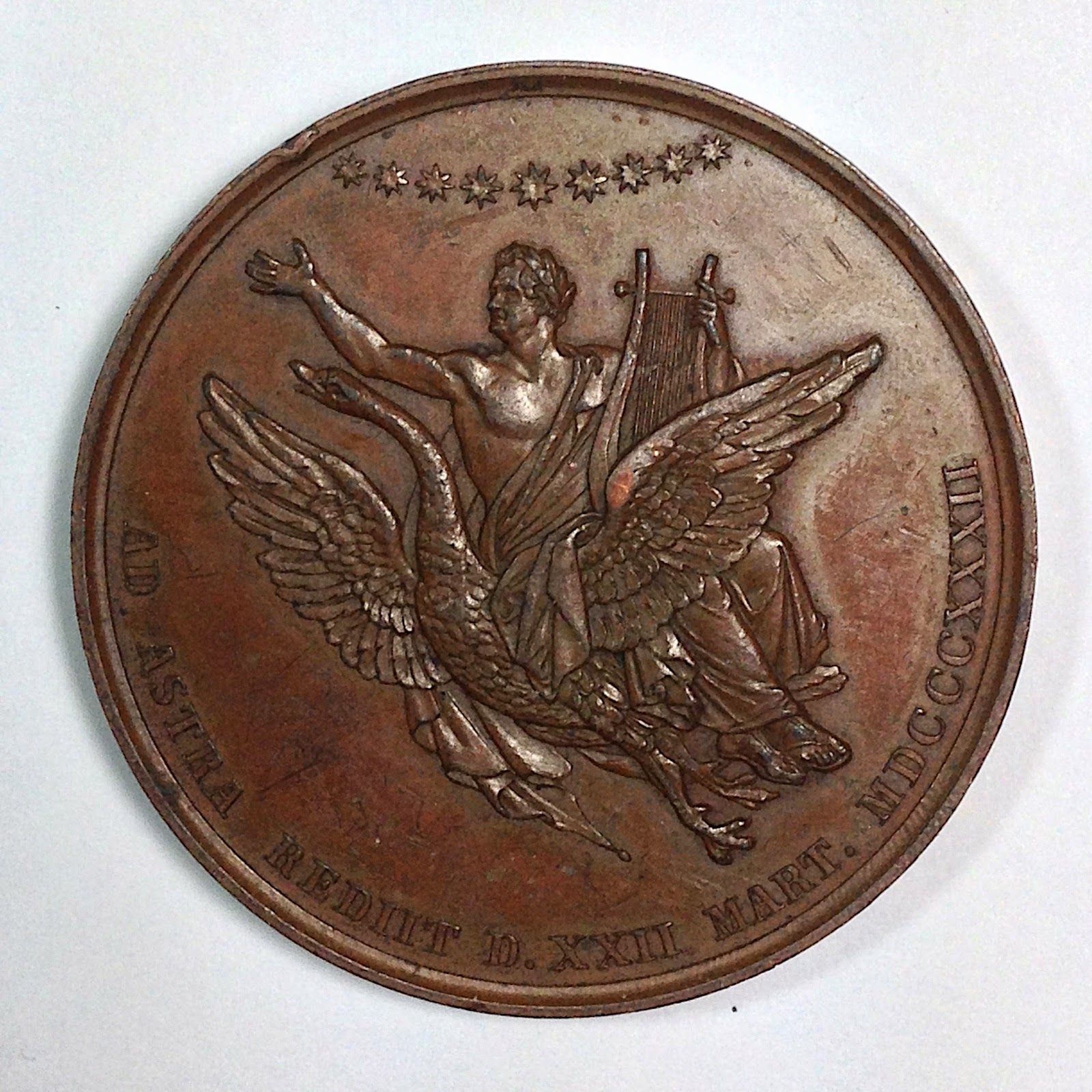
Medal: Death of Johann Wolfgang Goethe, 22 March 1832

March 22 is the death anniversary of Johann Wolfgang von Goethe, generally regarded as the greatest German author: culturally, for Germans, the equivalent of Shakespeare for the English or Dante for the Italians.

Goethe lived much later (1749-1832) and thus did not play quite the comparable role in the formative development of the vernacular (that role fell to Luther, though it was only in the 18th century that German, in the words of Eric Blackall's pioneering study, truly emerged as a "literary" language), but his influence was immense and his erudition far more wide-ranging. His work ranged from poetry, drama, and the novel to art criticism and prescient scientific speculation on paleontology, geology, and evolution. Along with his collaborator and best friend Friedrich Schiller, he came to embody "Classical" German literature and aesthetics that set the ideal for the middle classes well into the twentieth century.

Although Goethe came to surpass Schiller in reputation (as well as outlive him by a generation), it was Schiller who became the true cult figure and idol of the educated bourgeoisie as well as large elements of the lower and working class.

When the American numismatist Horatio Storer of Newport attempted an inventory of commemorative pieces in the 1880s, he found "that the medals of Goethe are intrinsically, and as compared with others of a similar character, those of Schiller, for instance, extraordinarily rare." Undertaking such a survey at that time, without benefit of easy international communication and shipment (much less, the internet), and basing his conclusions on the (not always reliable) reports and reproductions  of others was a daunting task, but his generalization stands. Another difference, though he did not note it, is that all Schiller medals are posthumous.

This is one of the rare medals that he listed, issued on the occasion of Goethe's death. Storer was interested in medals involving figures who had some ties to medicine and science, and he notes that this one was "in the Lee collection, at the U. S. Surgeon-General's Office in Washington." The image below is from my own copy.


Engraver: Anton Friedrich König (1794-1844)
Produced by the famous Loos mint: in this period run by Gottfried Bernhard Loos (1773-1843) in Berlin.

Bronze. Diameter: c. 42 mm. (It was also issued in a silver version).

Obverse

Portrait bust of Goethe in late life, crowned with laurel, facing left.

Motto: IO. W. DE GOETHE NAT. D. XXVIII AUG. MDCCXXXXIX

[i.e. JO[hann]. W[OLFAGANG] VON GOETHE, BORN 28 AUGUST 1749]

Inscription in the shoulder: F. KÖNIG F.
Beneath that: G. LOOS DIR.


Reverse

In Storer's description:

"A swan raising Goethe, laureated and in antique garb, with his lyre, to the skies, which are typified by an arch of nine stars. His breast is partially bare, his right hand upraised, and he looks upward, seated upon the back of the swan."

The aesthetic may not be entirely our own, but Storer notes that "Rollet considers the reverse to have been 'nobly conceived and executed.'"

Motto: AD ASTRA REDIIT D. XXII MART. MDCCCXXXII
[i.e. he attained the stars 22 March 1832]


It was not unusual that an announcement of the medal appeared in The London Literary Gazette no. 817 of 15 September 1832:


It is perhaps more significant that the same basic text appeared here in our region of the northeastern American hinterlands, in The Rochester Gem: A Semi-Monthly Literary and Miscellaneous Journal..., 5 no. 4 (9 Feb. 1833):


One of my research projects is to begin to trace these patterns of communication involving numismatic commemoration of literary figures. Already I can see that the paths do not always run in straight, direct lines, and that our instinctive assumptions may be wrong. For example, the above two examples, from two different continents, separated by some five months, are virtually identical, apart from the spelling of the poet's name (a not uncommon issue in German as well as in English for some time) and punctuation. By contrast, earlier pieces published in New York City were clearly not the model for the Rochester notice.

Should any further proof be needed for the emergence of what Goethe called "world literature"--that is, a universal possession of all humankind, transcending national boundaries and appeal--of which he himself had now become a part? I think his shade would have smiled at the notice in the provincial New York paper.

Sunday, March 22, 2015

Trees and Forests on Ex Libris woodcuts by Jaroslav Dobrovolský

"To build a sustainable, climate-resilient future for all, we must invest in our world's forests. That will take political commitment at the highest levels, smart policies, effective law enforcement, innovative partnerships and funding."
Secretary-General Ban Ki-moon


March 21 is the International Day of Forests.

In celebration of that event, some tree- and forest-themed bookplates.


Czechoslovakia produced many outstanding makers of ex libris plates. There was a vibrant bibliophile and collecting culture, and production of these small graphics also offered artists an appealing opportunity to develop a clientele and steady income.

One of my favorites among these ex libris artists is Jaroslav Dobrovolský.


Born into a working-class family in 1895 in Lužice u Hodonína, South Moravia, he both taught and produced art. He also became involved in civic affairs, serving as district school inspector from 1935 to 1939 and mayor of Hodonin from 1935 to 1940. Because he was active in the leading military resistance group under the German occupation, the Nazis arrested him in 1940 and deported him to Mauthausen concentration camp, where he died of starvation and other maltreatment in 1942.

Ex libris plates, primarily in woodcut and linoleum cuts, featured prominently in his artistic activity. He produced plates for many major collectors and exhibited his work in numerous international shows. In 1936, he led the Czechoslovak delegation to the international ex libris exhibition in Los Angeles.

His ex libris work is still represented in collections ranging from the Museums of Fine Arts in San Francisco to the art gallery of New South Wales, Australia. He worked in a number of styles, including Czech symbolism, but he is equally well known for his naturalistic woodcuts depicting buildings and landscapes. Trees and forests figure prominently among the latter.

The sampling here provides one with a good sense of his characteristic style: for example, the combination of two variants of the same color.


F. Navrátilová, 1927 (89 Xx 115 mm)
two-colored woodcut for Marie Řezníčková, 1930 (75 x 115 mm)

two-colored woodcut for Karel Kocian, 1931 (86 x 136 mm)


atelier stamp on the reverse of the above plate listing, describing it as "Woodcut 1931" (date corrected in artist's hand)

2-colored woodcut for Marie Sehnalová, 1931 (79 x 131 mm)

2-colored woodcut for Heřma Kořinková, 1931 (64 x 106 mm)
2-colored woodcut for B. Kučera, 1931 (71 x 110 mm)
2-colored woodcut for V. and J. Kratký, 1932 (99 x 130 mm)

back of preceding: artist's stamp and stamp of famed Moravian 
book collector Ctibor Šťastný, for whom Dobrovolský also worked


2-colored woodcut for István Réthy, 1937 (93 x 124 mm)
As in other cases, Dobrovolský produced versions in several colors. 
(I have one in another, yellower shade of green, as well.)

Dr. K. Leischner, 1937 (97 x 137 mm)
Jaroslav Mrázek, 1937 (93 x 124)


Monday, September 1, 2014

A German Popular Rural Calendar of the Early Nineteenth Century

In our information-saturated world, we take the ability to read for granted, and so, when we consider previous eras of history, many of us operate with simplistic assumptions about literacy and illiteracy, e.g. assuming that the world was largely illiterate until and because, well . . . .

I always tell students: reading is a skill that takes some effort on the part of the would-be reader, and in addition, the effort of someone willing to inculcate that skill. One may therefore apply the legal phrase , "cui bono": to whose benefit? In other words, people generally learn to read only when it is useful and/or when society as a whole considers it useful. It is not surprising that US plantation owners forbade their slaves to learn to read. It is likewise no coincidence that (1) already in the late fourteenth century, Florence--a center of commerce and politics--had basic public education (for both boys and girls) and an army of notaries, lawyers, and civil servants, whereas (2) in largely rural Central and East Central Europe, illiteracy is generally said to have remained at about 70 percent at the end of the eighteenth century. In fact, as late as 1881, in the backwaters of the Austro-Hungarian Empire, illiteracy apparently ranged from 57 to 83 percent (though not among my ancestors).

In 1776, the Prussian landowner and pedagogue Friedrich Eberhard von Rochow described the goal of education for the common people as: "to form good Christians, obedient subjects, and capable farmers." Scholars continue to debate the developments in this threshold era between the popular Enlightenment and the beginnings of a modern popular education movement--circa 1770-1830--precisely because it was so crucial but the evidence is so limited or laconic. Among the issues are both the motives of the reformers and the agency of the peasants. As far as we know, traditional rural reading consisted primarily of religious texts; works of a sentimental, escapist, or sensationalistic character; and above all, calendars or almanacs. Still, even if we have some idea of what the peasants read, or what others wanted them to read, it is much more difficult to know how they read.

The calendars ranged from minimalist types containing the days of the year and meteorological or other concise practical information to more expansive ones that also contained a wide range of other content, from anecdotes to superstition and fantastic tales. Collectively, they were the equivalents of the well-known US Old Farmer's Almanac and Farmer's Almanac (founded 1792 and 1818, respectively, and both still published today). Reformers sought to adapt the form as a vehicle for their ends, and during the French occupation, there were even revolutionary calendars.

One example of the minimalist variety of calendar in my personal library is:

Allgemeiner Kalender auf das Jahr Christi 1828, welches ein Schalt-Jahr von 366 Tagen ist. (Universal Calendar for A.D. 1828 [literally: the Year of Christ 1828], which is a leap year of 366 days.). Steyr, printed by Joesph Greis.
87 x 112 mm

The booklet contains the more or less obligatory array of features.

The woodcut cover illustration was a stock piece, reused year after year, part of the "branding" of the product. It can be tempting to overinterpret such images, about whose origins and intent we know far too little: temptation is often a thing best resisted. Against the backdrop of a rural landscape--castle- or church-like structure at left, and large, comfortable dwelling at right, a middle-class man, identifiable by his garb, observes the heavens with a telescope--emblem of science and erudition. Next to him, a peasant with a spade stands and extends a free hand: in greeting? explanation? We cannot tell.

Still, at the least, the image clearly serves to locate the calendar and its intended purpose in the social and intellectual world of the day, between learned and popular culture.  Taken together, the two figures encompass the standard content of the book: calendars for each month, along with meteorological information and folk wisdom.

As the location--Steyr is in Upper Austria--indicates, the calendar is aimed at a Catholic audience in the Habsburg Empire. Accordingly, the first pages of the calendar are devoted to crown and church.


At left: the birthdays of the members of the royal family of Austria.

At right:
top: the Numerus aureus, solar and lunar cycles, and the like, necessary for the calculation of religious holidays in the Gregorian calendar  (these would have required the use of additional tables or other information), as well as the time from Christmas to Ash Wednesday.

middle: moveable feast days, according to the Roman Missal.

bottom: the Ember Days.

Each monthly opening began with the names in both the modern and traditional Germanic form, and a woodcut emblem of the month including the zodiacal sign and characteristic activities of the season--here, for January: Virgo, a domestic meal, and warming oneself by the fire.

Additional information included length of the day, phases of the moon, sunrise, and general weather conditions. Reflecting the defining role of the Catholic Church, each day is marked by its saint's name, and the weeks, by a relevant Scriptural passage.

On the relevant days, as the previous opening explained, obligatory fast days were marked with a red cross.


The pages following the monthly calendars provided additional information on phases of the moon and length of daylight, as well as traditional folk wisdom.


E.g. for January:
When on S. Vincent's there's sunshine, one therefore hopes for good wine.
And for February:
When it rains after the new moon, then it will rain for a full month.
In this case, we even know something about the printer-publisher, Greis.


He occupied a historic Gothic house located at Grünmarkt 7. The original structure burned in 1552 and was rebuilt and then occupied by many generations of owners--from 1732 into the twentieth century, exclusively printers, who passed the property along to others in the trade through marriage (as was not infrequently the custom in that day) or sale. Joseph Greis (b. 1773) began as a compositor (typesetter) in the shop and acquired it from Franz Joseph Medter in 1804. 1827 was evidently a banner year for him: he married (for the second time) in January, and on 26 September, he also opened the town's first bookshop (Stadtplatz 23). In fact, it would have been just about this time that he issued the calendar that is our subject here: calendars and almanacs generally appeared at the start of the autumn season so that customers could purchase them conveniently in advance of the new year. (This was in particular important in the case of the more elegant literary or other Taschenbücher or almanacs--in the US, we would call them annual "gift books"--which sometimes had to go through several printings, depending on demand.)

In the mid-1790s, in the context of the French Revolution, Austria and Prussia restricted circulation of some foreign "calendars," so some publishers of almanacs or gift books simply deleted the calendar texts in editions destined for those regions.

This copy bears a revenue stamp, for 3 Kreutzer. Under the revised stamp tax regulation of 1819, Austrian calendars were taxed at either 2 or 3 kreutzer--whereas the more elegant almanacs that contained a calendar required a far higher tax of 12 kreutzer: as clear a sign as any of the economic and cultural hierarchy at work here.

Precisely because the more humble publications such as that of Greis were ephemeral--intended for practical use of limited duration--most have disappeared. They wore out and were thrown out. This hardy survivor shows his wounds.


A complete copy (here, the 1823 volume via GoogleBooks) ran to 20 leaves (40 pages), but my copy has only 30 complete pages and a fragment of 31-32. Still, it somehow survived.

In fact, the three large notches on the left, or binding, edge, indicate that it must have been part of a larger volume. (They are too large for what would be required to stitch together a work of this slim size, and if that had been the only purpose--that is, if it stood alone--they would not have been removed.) Owners sometimes bound together multiple issues of the same serial, and sometimes combined publications of different titles within the same volume. We may assume--but not be certain--that the former was the case.

But the question remains: why would one have kept a work designed to be ephemeral? We know a good deal about some of these publications as texts, material objects, and objects of commerce--but still far too little about how they were actually used.

The Un-Bomb (1): Former Baroque Armoury Turned Library

Ever since Isaiah had a vision of men beating their swords into ploughshares, it has been pleasant to imagine or witness other examples of the tools or symbols of war being converted into those of peace. I've posted a few examples over on the Tumblr.


Full series of images plus commentary: Books, Not Bombs

Sunday, January 6, 2013

Artifact of the Moment: Reflections on Nativity Scenes in Two Eighteenth-Century German Bibles


I am more behind than usual in sending traditional paper/print holiday greetings. For a variety of reasons, I didn't manage to get out any Christmas cards, as such, in time for the holiday. But I did at least manage to reflect briefly on some of the iconography associated with the occasion.

Here is an image that I've customarily used on one of the greeting cards that I send. It comes from my research into German book history.

The Nativity: Vignette from the Gospel according to Saint Matthew


(enlarge)

The unsigned copper engraving (approximately 10 x 19.5 cm) is from my battered but treasured copy of: Biblia, Das ist: Die gantze Heilige Schrifft Alten und Neuen Testaments : nach der Übersetzung und mit den Vorreden und Randglossen D. Martin Luthers ... / ausgefertiget unter der Aufsicht und Direction Christoph Matthäi Pfaffen, der Heil. Schrifft Doctorn, Professorn, Cantzlern und Probsten zu Tübingen, auch Abbten des Closters Lorch. - Mit Censur des Hochfürstl. Würtemberg. Consistorii und Löbl. Theologischer Facultät zu Tübingen, auch Allergnädigsten Privilegiis (Tübingen: Verlegt und gedruckt von Johann Georg und Christian Gottfried Cotta. Im Jahr Christi 1729).

The massive folio volume, illustrated, and edited with commentary by Professor Christoph Matthäus Pfaff (1686-1760) of the University of Tübingen, was at once a bibliophile production, thus a representative declaration of Christian faith (simply owning such a large and expensive work was a statement of sorts), and a pragmatic attempt to bridge theological differences in an age in which Lutheran orthodoxy contended with pietist challenges in the Duchy of Württemberg, which remained a bastion of hard-core Evangelical Protestantism in the otherwise largely Catholic German south.

The iconic scene of the Holy Family in the stable stands at the beginning of the Gospel According to Saint Matthew, thus introducing the New Testament as a whole (the other Gospels are not similarly graced with vignettes).

The Gospel of Matthew, as such, of course, mentions none of this. Instead, after a long genealogy establishing Jesus' necessary descent from King David, and the story of the Annunciation, it leaps right to the birth of Jesus. But there is no mention of the details, or of a location more specific than the messianically mandated Bethlehem. Instead, we suddenly read of Herod's concern over the birth of the King of the Jews when the three Wise Men, having followed their star, arrive in Jerusalem. Only after Herod interrogates the "chief priests and scribes" do he and the Magi learn that the goal of the latter should be Bethlehem. And even then, the gospel refers only to "the house" in which they find "the young child with Mary his mother." That's all. They present their gifts. Then warned in dreams by God and an angel, respectively, the Wise Men and the Holy Family flee the wrath of Herod.

Our cozy and canonical image of the Nativity, as depicted in many a work of art, comes from the Gospel according to Saint Luke, (The Gospels of Mark and John do not even deal with the Nativity and instead leap right into the career of the mature Jesus.)

And even then, there are no details. Luke contains the familiar assertion that Mary "brought forth her firstborn son, and wrapped him in swaddling clothes, and laid him in a manger; because there was no room for them in the inn" and that the shepherds, having heard the message of an angel and the heavenly host, "came with haste, and found Mary, and Joseph, and the babe lying in a manger." That's it. And a manger, contrary to popular opinion and my childhood impressions, is not a stable, and rather, as the etymology implies, something that one finds inside a stable: a trough or feeder for livestock, thus suitable to act as a sort of ersatz crib for the baby Jesus. (For that matter, the whole Nativity narrative is historically problematic; most recently, archaeologists have suggested that the actual birthplace was Bethlehem in Galilee rather than Judea.)

The rest, with its familiar regiment of barnyard fauna, is the accretion of tradition, though quite understandable as something that would appeal to the lifeworld and sensibilities of a largely agrarian Europe in the coming two millennia and to us now conveys a kind of nostalgic Gemütlichkeit.

The image in this Bible therefore embellishes the scene in that vein. Within the Baroque frame of sinuous and symmetrically curving curling acanthus leaves is a barn or stable, though a rather artificially neat and clean one. And, although there are hay racks for the livestock all around the perimeter of the structure, the little manger holding the baby Jesus stands at the center: unrealistic and out of place in a practical sense but theologically exactly where it needs to be. To the left are Mary and Joseph (the latter depicted, according  to tradition, as elderly—perhaps in order to downplay any suggestion of sexuality). To the right are the shepherds (identifiable by their staves) in their customary poses of obeisance, from kneeling to respectfully standing in contrapposto. In a sense, they pull our attention to the right, and in emphasizing the miracle and message that brought them hither, seem to violate the symmetry, but the presence of the larger livestock in the left foreground (those at the right are depicted as smaller and in the background) exercises a countervailing weigh so that visual balance seems to be maintained in the aggregate.

Embodying as it does the most popular conception of the Nativity, the scene from Luke thus serves as a visual introduction to the New Testament as a whole. Emphasizing this, the frame bears in its corners the traditional iconographic representations of each of the four Gospels, reflecting the chief attribute of each book: the bull (Luke), the lion (Mark), the angel (Matthew), and the eagle (John).

The sophistication of this image, from its complex composition to the refinement of the figures and the elegant cross-hatching, is all the more apparent when we compare it with a later and and more humble counterpart. The 1729 Cotta Bible, as noted, was a luxury work, for the theologian and scholar, or for the patrician elite. The ordinary folk purchased something a good deal simpler and cheaper.

Both the Cotta firm and its competitors also published budget Bibles in the more common octavo format. (Think of a book with covers whose dimensions are akin to those of a typical modern paperback, or somewhat smaller than those of a Kindle, but which in this case is, of course, a good deal thicker: some two to three inches/5 to 7.5 cm.) In 1793, the young Johann Friedrich Cotta (1764-1832), who would become the greatest scion of the family, earning it world renown as the publisher of the German Classicists and Europe's leading liberal newspaper, brought out out 5,000 copies of one such volume (by contrast, new titles in his catalogue at that time typically appeared in pressruns of only 500-1000 copies). It contained no illustrations, as such, only a few modest standard printers' ornaments or vignettes to mark the transitions between sections.

Meanwhile the Tübingen printer and notorious pirate publisher Wilhelm Heinrich Schramm (who also worked for Cotta on other projects ) had brought out a revised version of his own cheap edition of the Holy Scriptures:

BIBLIA, Das ist: Die ganze Heil. Schrift Alten und Neuen Testaments, nach der Teutschen Uebersetzung D. Martin Luthers ... (Tübingen, drukts und verlegts Wilhelm Heinrich Schramm, 1791

The common title page for both Testaments in my copy is dated 1791, but the separate title page for the New Testament bears the year 1794:

Das neue Testament unsers HErrn und Heylands JEsu Christi, verdeutschet durch D. Martin Luther... 
 (Tübingen, drukts und verlegts Wilhelm Heinrich Schramm, 1794)

The illustrations in this volume are fewer and simpler (and of course smaller) than in the Cotta folio Bible. To begin with, they are woodcuts rather than copper engravings, and thus allow for less detail. Even taking that into account, though, they are cruder in composition as well as line.

The elaborate Baroque frame of the engraving in the 1729 folio gave the scene an almost theatrical appearance, so that we had the sense of being privileged observers, looking in on a scene in which the holy actors go about their sacred business unaware of us.  (Not for nothing did nineteenth-century critics liken the proscenium stage, with its sharp separation of audience and players, to the Guckkasten—peep show, or peep box—of the village fair.) It was thus at once realistic and unrealistic.

Nativity Scene: c. 3.5 x 1.25 inches/ 9 x 3 cm


Here the frame has been reduced to a bare minimum, and the effect also differs in other ways from that of its more elegant counterpart. Indeed, the four Evangelists seem imprisoned rather than framed by the stark black border. (St. Matthew, at upper left, looks absolutely desperate to escape its confines, which in the meantime seem to be crushing poor St. Luke at lower right.) Within the frame, there is no attempt to produce a realistic perspectival architectural setting: instead, the background consists mainly of an undifferentiated series of vertical lines. There is a sort of flatness to the whole. The human forms are similarly simplified and flattened. It is tempting to call them cartoonish. Certainly, they are not particularly elegant or accomplished. From the standpoint of both composition and execution, then, the Schramm woodcut may seem clumsy. The frame is simple, the background is simple, the figures are crude.

That said, there is a kind of naive charm and rustic vitality to the whole.

Mary's devotion is apparent, even though the head of the baby Jesus looks like one of those schematic skulls on a Puritan gravestone. Although somewhat obscured by the forequarters of the horse or donkey in the background, the bull at left turns his head to the right, captivated by the array of figures paying homage to the infant. Further drawing our attention to the mother and child is the outstretched arm of Joseph (for we assume that the commanding gesture identifies him, even though the staff might otherwise suggest one of the shepherds) above, despite (or because of?) his lobster claw of a hand.

And even the compositional clumsiness may ironically work to the artist's and reader's advantage: although the figures awkwardly fill the space to the extent that we fear they will bump their heads on the solid black border, there is somehow a sense of immediacy lacking in the more polished engraving of the 1729 folio. As a result, we feel ourselves to be not voyeurs, but participant-observers in the miraculous scene.

Upon reflection, then, one might just conclude that this print brings us closer to that presumed stable and the lifeworld of Judean peasants some two thousand years ago than does its more elegant Baroque counterpart. In any case, it was by means of simple images such as these that the average Christian in Central Europe formed a picture of the Nativity some two centuries ago.

Friday, November 30, 2012

New Leaders at Hampshire College Library: Library Director Jennifer Gunter King and Archivist Jimi Jones


Good news really deserves full and proper coverage, but since I am (for a variety of reasons) unable to give it that at the moment, I'll take solace in the fact that it also speaks for itself:

In the interval since my first mention of our library search, Hampshire College has made not one, but two outstanding hires, the first for the position of Director of the Library, the second for College Archivist. I was a member of the search committee for the former and attended the candidate talks and offered feedback for the latter. As it happens, I was personally acquainted with the successful candidate in the former and was familiar with the work of the latter. I could not be happier.


Welcome, Jennifer Gunter King and Jimi Jones!

Our new Library Director is Jennifer Gunter King, whom I have known for five years, since we worked together on the "Bookmarks" events of Museums 10, the consortium of Pioneer Valley Museums. Arranging book-related exhibitions and programs engaging institutions from the Emily Dickinson Museum (obvious) and Five College art museums (logical enough) to the Amherst College geological museum (now, that was a tough one) was no mean trick, and it is no understatement to say that Jennifer's energy and creativity were a driving force behind the series, its intellectual conception, and its success. (program site here; I posted a few brief descriptive reports on the first half of the program here; Roger Mummert of the New York Times wrote about the exhibition and the general book culture of the area: "In the Valley of the Literate.")

Jennifer, until now head of Archives and Special Collections at Mount Holyoke College, has many talents. Trained to work in traditional rare print and manuscript sources, she is also passionately committed to doing the work of the present using the tools of the present, and geared to the distinctive needs of Hampshire College. For example, given that we do not have traditional "special collections" involving internationally famous rarities, and rather, documents mostly associated with the personae or general mission and values of the young college, she sees the need to highlight student and faculty work, to digitize and publicize our current cultural production.

I'll let her explain her approach herself in this profile, published at the time of her hiring in March. Among other things, it said, "At Hampshire, she believes it is essential to showcase the intellectual output of the Hampshire community past and present. Because of the preponderance of work done in new media, King wants to make sure that, from an archival and research perspective, work isn’t lost due to a lack of ability to preserve and showcase those materials."

This philosophy meshes perfectly with that of our new archivist, Jimi Jones. He comes to us fresh from a prestigious position at the Library of Congress, with equally impressive credentials and an equal commitment to both cutting-edge practices and the distinctive mission of the College. Although I had not met Jimi before his campus visit, I was familiar with his regular blog posts on "The Signal," the digital preservation blog of the Library of Congress. What impressed me was not just his expertise in these specialized (though today becoming the norm) areas, but also his historical perspective and breadth of vision. Like Jennifer, he understands the role of digital media.

Like Jennifer, he also has multiple talents and varied interests, extending, for example, to art, and in particular, the book arts, with which he was involved at the University of Utah. Book arts, perhaps because students have a new appreciation for the physical and the tangible in an increasingly "virtual" age, have become very popular since we founded the Center for the Book here at the end of the last century (sorry, can't help myself: just like to use that phrase). The two worlds came together recently just around the time of Jimi's arrival with our very successful "Pulp to Pixels" program and exhibit (blog here), funded by a Five College Mellon grant for digital humanities. Jimi hit the ground running, and his energy, approach, and talents can be appreciated from this report, which he posted on our Hampshire Media Tumblr.

Not only do these hires bring to us two talented leaders of their respective departments or domains. They will also be a wonderful stimulus to all aspects of our Center for the Book, which understands "the history of the book" as the study of the technologized word, thus embracing the entire sweep of development from the origins of writing to today's "new" media.

Obviously, great hires such as these are good for the College in a direct and practical sense. More generally and perhaps more important, though, the decision of these two highly qualified professionals to come here when they could be highly competitive and sought-after candidates anywhere, is a real vote of confidence for the accomplishments and prospects of the institution. These days, Hampshire College, under the leadership of new President Jonathan Lash, is feeling a new sense of energy and collective purpose as it continues to fulfill its mission of preparing students to learn and live in an ever more complex world in which the liberal arts must retain their value even as the nature of knowledge and information are changing at an unprecedented pace.

Monday, April 2, 2012

Meet New Hampshire College Library Director Jennifer Gunter King


From the Hamphsire College web site:

There are clichés that tend to define the idea of a library: Unbreachable quiet that stretches through long, dark expanses of book stacks. The smell of old paper and dried ink. Quiet corners and carrels where solitary work plods slowly along.

Jennifer Gunter King, Hampshire College’s new director of the Harold F. Johnson Library, isn’t a huge fan of that vision. 

Jennifer Gunter King
“The library today is in the process of evolving from a repository into a center that functions as a hub and gateway to all sorts of resources,” she said. “The library director position in a place like Hampshire, which already embraces a philosophy of pushing the envelope, is well poised to figure out what the library of today and tomorrow looks like.”

To King, that means looking beyond the paper foundation most libraries are built on. With master’s degrees in library science and history from the University of Maryland, College Park, King understands that the fundamental shift from paper to digital means restructuring the library to be as robust virtually as it is physically.
[read the rest]

Saturday, October 1, 2011

Hench Post-Dissertation Fellowship

In recently discussing the awarding of the SHARP DeLong Book Prize to John B. Hench, I referred to his great service over many years at the American Antiquarian Society (AAS), a service recently honored through the creation of the Hench Post-Dissertation Fellowship.

It is now time for a new round of applications.  From the press release by the AAS:
Scholars who are no more than three years beyond receipt of the doctorate are invited to apply for the Hench Post-Dissertation Fellowship, a year-long residential fellowship at the American Antiquarian Society. The purpose of the post-dissertation fellowship is to provide the recipient with time and resources to extend research and/or to revise the dissertation for publication. Any topic relevant to the Society's library collections and programmatic scope, and coming from any field or disciplinary background, is eligible. AAS collections focus on all aspects of American history, literature, and culture from contact to 1876, and provide rich source material for projects across the spectrum of early American studies.

The Society welcomes applications from those who have advance book contracts, as well as those who have not yet made contact with a publisher. The twelve-month stipend for this fellowship is $35,000. The Hench Post-Dissertation Fellow will be selected on the basis of the applicant's scholarly qualifications, the appropriateness of the project to the Society's collections and interests, and, above all, the likelihood that the revised dissertation will make a highly significant book. Further information about the fellowship, along with application materials, is available on the AAS website. Any questions about the fellowship may be directed to Paul Erickson, Director of Academic Programs at AAS, at perickson@mwa.org.

The deadline for applications for a Hench Post-Dissertation Fellowship to be held during the 2012-2013 academic year is October 15, 2011.

Sunday, September 4, 2011

What G.I. Joe Read

As I recently noted, John Hench's excellent study of Books as Weapons, on the US harnessing of publishing for political purposes in the World War II era, just won a well-deserved prize for best book of the year from the Society for the History of Authorship, Reading and Publishing (SHARP).

Most of us were previously unaware of this colossal effort, particularly as it concerned the attempt to promote American books among the European population. More of us may have come across the cheap editions produced for US soldiers. Still, as even these latter are probably unfamiliar to the average reader, I thought it might be useful to present one of them here. The images are no substitute for the object itself, but they, along with John's excellent research, help to give some impression of what the books were actually like.

As the book explains, the first concerted attempt to provide US soldiers with reading material proved unsuccessful. The "Victory Book Campaigns," a joint effort of the USO, Red Cross, and American Library Association, failed because they "depended on the voluntary contribution of used books by civilians at home," an approach that "proved to be both inefficient and ineffective." (pp. 51, 84). As many a modern librarian or organizer could have told them: volunteer efforts can be unwieldy, the more so when it comes to book donations, which tend to attract precisely the sorts of things that neither donor nor recipient really wants. The weight and wide variations in the size and shape of the books also complicated the logistics of what was to have been a massive undertaking.

The Council on Books in Wartime (CBW), a collaboration among trade book publishers, librarians, and booksellers, therefore decided to make its own selections and produce its own editions, which could be sold to the military. The result was the spectacularly successful Armed Services Editions (ASE). The effort was as noteworthy for its approach and production methods as its results. It was prescient in that it took as its model the still-young paperback revolution and sought to take advantage of the distinctive characteristics of the wartime economy.

Standardization and a creative approach to design proved to be as important as the content:
In contrast to the widely differing sizes and formats of the Victory Campaign, the ASEs were lightweight, mostly oblong paperbacks, printed ‘four up’ and then thrice guillotined to create four books with the series’ characteristic, nonstandard orientation. They were printed on roll-fed rotary presses used in peacetime for magazines and catalogs, which had capacity in excess of the demands of civilian life. They appeared in two different trim sizes—6 ½ by 4 ½ inches (i.e. half the size of a magazine like Popular Mechanics) and 5 ½ x 3 ½ inches (i.e. half the size of a Reader’s Digest and similar periodicals)—which made packing and shipping comparatively easy. The text was printed in two columns on these oblong pages, a design, it was claimed, that did not exhibit the crowded effect that vertical two-column pages displayed. It also held the lines to legibly short lengths. These various design and technical innovations made the production and distribution of the ASEs feasible, even little short of miraculous. (p. 52)
ASE produced 122,951,031 copies of 1,322 titles from 1943 through 1947.

It so happens that I had one such edition in my own library, an item that I picked up for a few cents a good many years ago (I believe: at the League of Women Voters' book sale here in Amherst). It's by Ernie Pyle, the most famous US combat journalist of World War II. Killed by a sniper in 1945, Pyle, as the Indiana University School of Journalism puts it, was "An early "embedded journalist," who "worked alongside the troops, experiencing much of what they did, placing himself in danger as they did. His columns captured the scene and his reporting humanized the war for many of his readers." Pyle produced two bestselling collections of his writing, Here is Your War (1943) and Brave Men (1944-45), which were also issued together under the title, G.I. Joe.

The ASE edition of Here is Your War is in the larger of the two formats:

cover
inside cover
title page
first page, showing the unusual double-column horizontal orientation
back inside cover, with list of selected other titles in the series
back cover
The success of the program was measured not only in copies, but also in consequences. As John summarizes:
In setting up the ASEs, council members were confident that the series would contribute to the ‘mass reading of books in the world to come.’ They were right. Historians have generally credited the ASEs with introducing books to the GIs who had read little before the war, for helping fuel the paperback boom in the postwar years, and for creating a new pool of customers. (p. 53)

Not bad for an improvised response to a national emergency. One wonders what equivalent efforts could be undertaken today to enrich the lives of our soldiers and better equip them for the return to the United States and, eventually, civilian life in the age of the information economy.

Sunday, August 14, 2011

Gotta Love Those Romance Titles (or: the price of freedom is eternal kitsch)


The American politicians and publishers who, in the title of John Hench's prize-winning book, sought to use "Books as Weapons" in the war against fascism, thought they were making the world free for democracy. Of course, they were also making the world free for free markets, and thereby, not just for Hemingway, Steinbeck, Saroyan, and the other authors whom they held up as models of civic engagement and cultural achievement, but also for all sorts of literary trash.

To put it another way: the price of liberty is eternal kitsch. Of course, that's the price of "totalitarianism," too, though in different ways and for different reasons. While I was in Prague this spring, I saw a massive and fascinating exhibition on the stifling of modernism and the avant-garde, first, by the Nazis, and then by the communists. 

For many of us, the romance novel epitomizes American literary kitsch. To be sure, the genre and its readership have become the subject of scholarly study: one thinks first and foremost of the pioneering work of Janice Radway, who provocatively argued against the dominant condescension toward both.

Sorry, I digressed: I was starting to risk venturing into the serious, which is not at all my purpose here.

Anyway, when it comes to the romance novel, many of just appreciate the lame titles and cheesy cover art. The titles may not be as distinctive and clever as those of classic country and western songs, but like them, they do adhere to certain conventions and constitute a sort of subgenre in their own right. In this case, though, one suspects that the humor is accidental, or at any rate, if implicitly part of the publishers' intent, not uppermost in the minds of their consumers.

This spring, as the Amherst Historical Commission prepared to put forward a request for Community Preservation Act funds for the restoration of paintings hanging in the Jones Library (still need to post about that), I took a stroll through the building to re-familiarize myself with the location of each work of art.

Lo and behold, I came across one of the canvases— Paul Dominique's late 19th-century "Arabs Mounted in Battle"—hanging over: the romance collection.


To me, it actually seemed entirely appropriate. Whereas some might see a glaring contrast between this "high" work of art—after all, it's an oil painting more than a hundred years old, in an elaborate gilded frame (what more need one know?)—and the genre literature of mass cultural production below, I see but variations on a theme.

To be sure, the painting is "historically significant" (otherwise we could not fund its preservation), and reasonably competent, but it is a typical piece of orientalism, depicting the exotic "otherness" of Arab culture for the delight of the western viewer. Unlike a book published in a pressrun of tens or hundreds of thousands of copies, Dominique's painting is a cultural product that exists in but one exemplar, and yet for all that, it is interchangeable with dozens if not hundreds of others. In its own way, it is every bit as conventional as the romance novel—and conventional ideals, representations, and sentiments are the hallmarks of kitsch.

And of course the connection doesn't end there. The Arab male has long functioned as a figure combining danger and allure. One need but think of Valentino and the vogue of "the sheik" theme, derived from the novel of the same name by E. M. Hull (whose real name was not the same: Edith Maude Winstanely). In fact, as the publishers of the new edition remind us, "The Sheik is recognized as the immediate precursor to the modern romance novel." Apparently, the theme has even been making something of a comeback. Oy (as they say). [this ¶ was accidentally omitted from the original upload.]

A classic debate in library philosophy has been whether to collect comprehensively or selectively: as much as possible, or only "the best": what Matthew Battles called the distinction between the "universal" and "Parnassan" ideals of the library. On the local level, this most often gets translated into debates about whether to purchase popular fiction, controversial political works, and the like. Romance novels are among the most contentious genres. The limited evidence suggests that most public libraries do have fairly extensive holdings of romances, though precise patterns of acquisition and funding are less clear. Most libraries have a romance novel collection because there is public demand for it and they serve the public; and there's nothing wrong with that.

Damn. I keep getting serious. Must. Stop. Now.

So, back to those romance titles and covers. One of my favorite "tweeps" and library bloggers, Rita Meade, a.k.a. Screwy Decimal (here, the blog; here, the Twitter account; further: 1, 2, 3) has made a minor art of chronicling the inanity and inadvertent humor of romance titles and romance novel culture—to which she adds her own very intentional humor under the rubric, "Romance Title of the Day," e.g.:
• 'Sex in the Middle Ages.' Well, I hope they practiced serf sex.

 • 'His Virgin Secretary.' Well, I guess it's something to put on the ol' resume.

'His Pregnancy Bargain.' I love when a man puts the "us" in uterus
I promised Rita I'd share some of our local examples.

At any rate, without further ado, here's my modest contribution. My favorite is One Fine Cowboy: He's got a way with horses. . . and with women . . . . Feel free to supply your own commentary. The possibilities are almost endless.

The Dangerous Baron Leigh

One Fine Cowboy

A Pregnant Proposal

Confessions of a Viscount
Your tax dollars at work.

Friday, August 12, 2011

Walking the Walk and Tweeting the Talk


According to a new survey released this week, web search engines and email are the most popular forms of digital media among the US adult population: some 92 percent of us use them, 60 percent of us, daily. Nearly half of us use social networking sites (SNS), such as Facebook. What is interesting is not just the increase in overall use of SNS (nearly doubled from 2008 to 2010), but also the changing demographic: both older and more gender-balanced. The average age of the social network site user has risen from 33 to 38, with half over 35. And, at 56 percent, women's participation now slightly outnumbers that of men. However, only 13 percent of us are on Twitter (though world-wide, we are 200-million strong).

Is Twitter, as so many acquaintances dismissively say, a faddish and foolish exercise in narcissism—a sort of metaphorical modern mashup of the twentieth-century "pet rock" and vanity license plate—or, as others maintain, a valuable social, intellectual, and marketing tool?  As an inveterate tweeter, I of course incline toward the latter opinion. The usage statistic alone, absent more granular data, could support either view. If it's a fad, though, it's certainly restricted to a relatively small population, but which: the proverbial "early adapters"? (if so, what is the profile?) gen-Xers? And just how do they use it? One of my "tweeps" (to you non-users: a Twitter friend, someone I "follow" or who "follows" me) perfectly summarized the competing views last month in a nice little blogpost entitled, "How to Use Twitter (and Why It’s Not a Waste of Time." There, she lovingly and originally characterized Twitter as: "the semi-colon of social media – people have an idea of your existence but many have not fully grasped your usefulness and beauty."

We are only beginning to study the significance of new social media, and Twitter is arguably the least-studied and least-understood among them. To be sure, there have been some rather silly pieces about use of Twitter in the classroom (spare me, please; I'd be happy if my students used spellcheck intelligently), but relatively few rigorous studies of its real value in the academic and cultural sphere, proper. I hope to address that question eventually. In the meantime, I instead wanted to do something much more modest, namely: share one example of how my colleagues and I recently employed Twitter for both academic and social purposes.

As I mentioned in my brief post on the SHARP conference on the book in art and science, social media are coming to play an increasingly important role in our gatherings, and not just in a trivial or recreational way. Last year, in Helsinki, we made full use of a variety of media. For example, we live-streamed some of the main events, such as keynotes and plenaries. Most novel, however, was our use of Twitter. Several of us began to tweet coverage of the events, simply because we tweet all the time. Several people who could not attend said that this coverage not only allowed them to experience the events from a distance, but even inspired them to join the organization. We could not have hoped for a more encouraging result.

This year, as an experiment, we decided to make tweeting an official activity. Many officers on the Executive Council—the President, Vice President, Treasurer ("That, uh, that, that would be me," as Bob Newhart used to say), Recording Secretary, and Membership Secretary—are already individually active (to varying degrees) on Twitter, and there is in addition a general SHARP Twitter account as well as a special one for this conference. "Official" here meant: explicitly endorsed and encouraged from above. In order to lend some material incentive to that moral exhortation, we even offered a prize—in the form of copies of the winner of the annual Book Award—to the ten top tweeters. (Among other things, that meant putting our money where our mouth was—and your Treasurer, I can assure you, does not disburse your funds lightly). We generated over 2000 tweets, archived here.

There were many pleasures, chief among them, the rewarding feeling of belonging to a community within a community (which is to say, as far as I was concerned, a more intimate alliance rather than any form of snobbery), and the excitement at the prospect of finally meeting at the conference, or at a separate "tweet-up" after hours, face to face, people whom one knew only by their usernames, and via 140-character snippets of conversation.

In the course of our (real-life as well as virtual) conversations, SHARP Board member George Williams, by day a professor of English at the University of South Carolina Upstate, who at night dons the cape and tights of heroic editor of the "ProfHacker" blog on at the Chronicle of Higher Education, asked the more active tweeters to write up brief reflections on their use of this social networking tool at the conference for his column.

Here's the beginning of my contribution:
To tweet or not to tweet? If I do not tweet for myself, who will tweet for me? If I tweet only for myself, what am I? Twitter, as one of my non-SHARP “tweeps” says, is the most misunderstood of social media. To wary outsiders, for whom it represents an exercise in egotism, I gently explain that it all depends on what you are looking for and whom you choose to follow. In the 4 years I’ve been on Twitter, it has become one of my most valuable research and networking tools. Frankly, I am much more interested in what total strangers on Twitter are reading than what my Facebook friends had for lunch or their kids did at the birthday party. . . .
George's introduction and the rest of the individual contributions can be found here.

What do you think? Comments welcome.

Books Into Battle: John Hench Wins Distinguished Award for Study of Propaganda and Publishing During World War II


It's always a pleasure to witness the announcement of the book award at the annual general meeting of the Society for the History of Authorship, Reading, and Publishing (SHARP).

I would have said it's "suspenseful," for that it is, too—for most members and conference attendees—just a little bit less so for me. As a member of the Executive Council of the organization, I get a heads-up well in advance of the actual moment (sworn to secrecy, if-I-told-you-I'd-have-to-kill-you, and all that sort of thing). And, as Treasurer, I have to write a congratulatory letter—and a check in the amount of $ 1000—to the winner:

 (Cornell University Press)

Even though I knew the outcome, this year's award was special in several ways. For one thing, as part of our promotion of Twitter at the conference, we promised a copy of the prize-winning book to the top ten tweeters. The volume thus got even more publicity than usual. For another, the winner was both an active SHARP member and a participant at the conference. Above all, though, I was absolutely delighted because that winner was John B. Hench, a man whose learning and generosity are matched only by his modesty.


When I started my career here in western Massachusetts, a colleague, knowing of my interest in the history of the book, brought to my attention the rich array of activities at the American Antiquarian Society (AAS) in Worcester. I got the best possible introduction to its resources, programming, and staff when I attended a summer seminar. It was invigorating to find myself again in the company of people who understood my research interests, even though I worked on Europe and they worked on the United States.

It was there that I got to know John, then director of publications. I was touched that he made a point of welcoming me personally. (Among other things, it was nice to meet another transplanted Midwesterner turned New Englander.) We saw each other periodically at AAS events and corresponded occasionally in the interim. Throughout the years, John worked tirelessly on behalf of the institution and its patrons, rising to the position of Vice President for Collections and Programs. When he retired in 2006, the AAS honored his accomplishments and the spirit of service that he embodied by putting his name on the post-dissertation fellowship program that he created. As the announcement noted, the budget of that program alone was by then greater than the budget of the entire institution when John came to work there in 1973.  It's hard to think of a more fitting way to celebrate his contribution to the organization, the field, and the careers of other scholars.

After I joined SHARP more than a decade ago, I was very pleased to learn that John was an active member. As chance, or irony, would have it, I haven't managed to make it to the AAS as often as I used to, so even though John and I live only about an hour and a half away from one another, I found myself more likely to run into him at least once a year at our conference in  places as distant as France or Finland. In fact, I still recall our meeting in Helsinki last year. As usual, we talked during the receptions and coffee breaks, and on at least one occasion, we also had lunch together. In addition, though, John came to my panel, where I gave a rather sweeping and speculative talk, testing some ideas on a subject I was just beginning to grapple with. He made a point of speaking to me immediately afterward and offering words of encouragement. Weighing the fact that John is just about the nicest guy in the world against the fact that he is also one of the smartest, who is invariably polite but does not dispense empty praise, I was simultaneously humbled and elated to conclude that my incipient idea was just perhaps not entirely nutty, and worth pursuing, after all.

My paper and one other on the panel dealt wholly or in part with Nazi Germany. Through SHARP, I had learned more and more about the breadth of John's knowledge and interests. If anything, he seemed to become even more active as he approached and then entered retirement. Having dedicated his career to the service of others at the AAS, he had begun to share results of a fascinating new research project, which involved not early America, but America in the era of World War II. I missed the 2003 conference in Claremont, California, where John first shared that research with SHARP members, but I did hear him speak about it in The Hague in 2006 and Minneapolis in 2007. John also explained the origins of the project in a recent interview:
Hench recalled how the war years had colored his upbringing. His father, a physician who was 46 when he volunteered for military service, was a collector of interesting, quirky books. His library included several of the editions published for soldiers fighting abroad.
Over time, Hench himself amassed a collection of ephemera. The assemblage included “ration cards, pamphlets, that sort of thing — really home-front propaganda — and some books on subjects such as how to behave in wartime: how to give a party, what to write to your husband, to be wary of the charms of an attractive man who was 4-F but otherwise fit,” he said with a laugh.
As he sought interesting material, he ran across a copy of an Overseas Edition. It was completely new to him, and his interest was piqued. After some initial research, Hench realized he had a potential book in the making.
What fascinated him, he said, was the idea that governments took books and culture so seriously as to see them as elements of national identity and weapons in a war of ideas. The title derives from a slogan of the World War II Council on Books in Wartime: “Books as Weapons in the War of Ideas.” As the interviewer explains, "The Nazis were portraying Americans as crass people who sought world domination. The books were intended to give Europeans an idea of the lives and values of ordinary Americans and to promote democracy." In order to counter the German view—and gain a foothold in new global economy—the United States government and military in effect got into the book business:
Some 5 million books published under the imprints of Overseas Editions and Transatlantic Editions were distributed in the ongoing effort. Some were translated into European languages, while many others were in English. They were chosen for the elites, who, it was believed, would influence their families and business and political leaders.
“It would be hard to find another time when the government bought into the professional ideology of publishers, with the power to mold minds and shape history,” Hench said.
It was, as Hench says elsewhere, an attempt to win the peace as well as the war—and new markets in the process.

The DeLong Prize Committee this year comprised Chair Marija Dalbello (USA), Amadio Arboleda (Japan), and Francis Galloway (South Africa), assisted by intern Lucy McClune. SHARP Director of Publications and Awards Claire Squires (Scotland) oversaw the entire process. As the Committee put it:

This is a book about war but it is also a book about the diplomacy of books. As an international and comparative history of wartime publishing, it presents deeply contextualized accounts, offering multiple contemporary perspectives, a true mark of scholarship that constructs the book trade as an international phenomenon. It will for sure make its mark in many fields, but it is deeply embedded in our own.
In making the presentation, Chair Marija Dalbello also cited an evocative passage from the text:
Only weeks after the D-Day invasion of June 6, 1944, a surprising cargo—crates of books—joined the flood of troop reinforcements, weapons and ammunition, food, and medicine onto Normandy beaches. The books were destined for French bookshops, to be followed by millions more American books (in translation but also in English) ultimately distributed throughout Europe and the rest of the world. The British were doing similar work, which was uneasily coordinated with that of the Americans within the Psychological Warfare Division of General Eisenhower's Supreme Headquarters, Allied Expeditionary Force, under General Eisenhower's command.


Last fall, the AAS honored John by calling upon him to deliver the prestigious annual James Russell Wiggins Lecture in the History of the Book in American Culture. Both the title—"Random Notes from a Book History Bureaucrat"—and the content reflect John's self-deprecating spirit. Although the focus there was on John's career at the AAS, he also talked about the research behind his new book.


John Hench-Nov. 16, 2010 from American Antiquarian Society on Vimeo.

He talks more specifically about the book in this C-SPAN interview in the spring of last year, commenting on, among other things, the place of the US and its culture in the upheavals of our contemporary world.


Congratulations, again, John, on your well-deserved honors: couldn't happen to a nicer or smarter guy.


Background and resources

SHARP began awarding an annual book prize in 1998. Since 2004, the award has been known as the George A. and Jean S. DeLong Book History Prize, in honor of the family that endowed it.

List of winners.

On the new SHARP blog, Director of Publications and Awards Claire Squires (Director of the Stirling Centre for International Publishing and Communication), offers some reflections on the history and significance of literary prizes, a topic on which she recently spoke at a conference in Tübingen.


Updates


The SHARP blog now has two perfect follow-ups:

In the first, Amadio Aboleda talks about his experience as a DeLong Prize juror. His remarks are not only germane to that rather esoteric task, but in fact pertain to most of what we as scholars do when we unavoidably have to make sense of works outside our field or area of personal expertise:
By the end of March, I had five books and no idea of how to go about reading them. None of them were in my own field of Japanese book publishing culture and many covered topics about which I knew little or nothing. . . . I was also worried that taking more time than other jurors to read books outside my own sphere of interest might delay a final decision. However, as I delved into unfamiliar pages I was reminded of my wonderful experience as a definition editor of the American Heritage Dictionary. Each editor had to read a certain number of books in a loosely defined area of their expertise every week to "absorb" information. The Dictionary had arranged with the New York Public Library main branch on Fifth Avenue to allow the definitions editors to request books that would be delivered to our office. I had the good fortune of being paid to read books. I realized that reading the entry books as a juror also could be considered good fortune and felt encouraged.
(read the rest: "Ying and Yang of a DeLong Book Prize Juror")

In fact, it is an example that I could cite when explaining to students the task they face in any new class.

In the second, John Hench himself responds to the award:
Like a fine piece of jazz, every book is both a collaboration and an improvisation. If there is anything we have learned from the study of book history, it is to understand the roles that mediators and even meddlers of all kinds play in the process that turns a gleam in an author’s eye into a published book. And anyone who has ever written a book knows that it is also a product of trial, error, and reconcepualization, that is, of improvisation. I would never have written Books as Weapons: Propaganda, Publishing, and the Battle for Global Markets had I not decided, about a dozen years ago, to begin to collect books, magazines, and newspapers published by private and governmental organizations to advance particular wartime agendas. In doing so, I stood on the shoulders of my father, smitten for life by the “gentle madness” of book collecting, whose stateside service in the army medical corps left me with a lifelong interest in World War II. I already knew about most of the wartime publication series. 
He goes on to discuss both the substance of his quest and the evolution of his research (much, again, thanks to exchanges of ideas with friends and colleagues), down to the choice of the final title.

(read the rest: "Collaboration and Improvisation")