Events

Monday, August 20, 2012

Overbooked


Hard to believe (well, maybe not) that I have been so inactive in this domain, but many things came my way this year, and when I had time to write, it was mainly for other venues or purposes.

But if all goes well, this site will now be more regularly updated. Not promising anything, of course.

Monday, April 2, 2012

Meet New Hampshire College Library Director Jennifer Gunter King


From the Hamphsire College web site:

There are clichés that tend to define the idea of a library: Unbreachable quiet that stretches through long, dark expanses of book stacks. The smell of old paper and dried ink. Quiet corners and carrels where solitary work plods slowly along.

Jennifer Gunter King, Hampshire College’s new director of the Harold F. Johnson Library, isn’t a huge fan of that vision. 

Jennifer Gunter King
“The library today is in the process of evolving from a repository into a center that functions as a hub and gateway to all sorts of resources,” she said. “The library director position in a place like Hampshire, which already embraces a philosophy of pushing the envelope, is well poised to figure out what the library of today and tomorrow looks like.”

To King, that means looking beyond the paper foundation most libraries are built on. With master’s degrees in library science and history from the University of Maryland, College Park, King understands that the fundamental shift from paper to digital means restructuring the library to be as robust virtually as it is physically.
[read the rest]

Saturday, October 1, 2011

Positions in the Pioneer Valley: Library Director, Hampshire College


Director of the Library
Hampshire College
Hampshire College, an independent, innovative liberal arts institution and member of the Five College consortium with Amherst, Smith, and Mount Holyoke Colleges and the University of Massachusetts at Amherst, seeks a highly accomplished professional for Director of the Library. Hampshire College, founded in 1965, offers approximately 1500 full-time students a full range of liberal arts programs through an interdisciplinary, inquiry-based curriculum. Hampshire students have access to more than 6,000 courses, 8 million library volumes, and the academic facilities of all five campuses. The institutions collaborate in many ways, including joint faculty appointments and the sharing of certain facilities and administrative functions. The College is located in the beautiful Pioneer Valley in Western Massachusetts and contributes to the rich cultural environments of the college towns of Amherst, South Hadley and Northampton.
The Director of the Library is the chief academic and administrative officer of the library. Reporting to the Dean of the Faculty, the director holds responsibility for coordinating programs, scholarship, and service activities within the Hampshire Library as well as within the Five College consortium, one of the oldest and most successful consortia in the country. The mission of the college library is to provide information resources and services in an exciting academic environment that supports Hampshire students in the development of innovative research and critical inquiry skills. The director will provide leadership in developing programs, services, collections, and digital/media asset management; provide leadership in evaluating and assessing library programs, facilities, space utilization, and construction projects, as well as collections, archives, and services; and ensure excellence in linking library information resources and information technology. The qualified candidate will set the library's fiscal priorities and direction consistent with strategic use of resources; foster a collaborative approach to managing the library and its personnel; and participate in fundraising, grant writing and developing donor relations to benefit the library. In addition, the director will be expected to develop collaborative relationships with the National Yiddish Book Center and the Eric Carle Museum for Picture Book Art. Built directly adjacent to the campus (and on land originally belonging to the campus), these two institutions comprise Hampshire’s “Cultural Village” and add to the richness and attractiveness of our corner of South Amherst.
An MLS degree from an ALA accredited (or an international equivalent) program is required; a second master's degree or a doctorate is preferred. A minimum of five years progressively responsible academic library experience in a supervisory/administrative capacity is required. The selected candidate must be a highly skilled leader able to respond to the emerging teaching, learning, and research needs of the College community; have an understanding of the academic process and trends in higher education, and a strong commitment to excellence in library service in support of the College's mission; and demonstrated commitment to fostering the library's essential role in the academic program. This position requires a strong background in emerging technologies as they relate to academic libraries; an understanding of issues related to scholarly communications and intellectual property; proven financial and personnel management skills; excellent interpersonal, communication, presentation, and negotiation skills; and a strong record of scholarly and professional achievement. The qualified candidate will possess the capacity to lead and manage a dedicated library staff; foster open communication and cooperative relationships in the college community, and have a commitment to working with a diverse constituency.
Review of applications will begin November 1, 2011. Hampshire College offers a competitive salary and excellent benefits program. Please submit your cover letter, resume and names/phone numbers of three professional references via our website at http://jobs.hampshire.edu/. Hampshire College is an equal opportunity institution, committed to diversity in education and employment.
The history of our institution and its library is a fascinating one, as we were pioneered many concepts and practices that have since become commonplace. Applications should of course be addressed to the above, but I am happy to share any historical background and insights that I have derived from my service to the institution.

Hench Post-Dissertation Fellowship

In recently discussing the awarding of the SHARP DeLong Book Prize to John B. Hench, I referred to his great service over many years at the American Antiquarian Society (AAS), a service recently honored through the creation of the Hench Post-Dissertation Fellowship.

It is now time for a new round of applications.  From the press release by the AAS:
Scholars who are no more than three years beyond receipt of the doctorate are invited to apply for the Hench Post-Dissertation Fellowship, a year-long residential fellowship at the American Antiquarian Society. The purpose of the post-dissertation fellowship is to provide the recipient with time and resources to extend research and/or to revise the dissertation for publication. Any topic relevant to the Society's library collections and programmatic scope, and coming from any field or disciplinary background, is eligible. AAS collections focus on all aspects of American history, literature, and culture from contact to 1876, and provide rich source material for projects across the spectrum of early American studies.

The Society welcomes applications from those who have advance book contracts, as well as those who have not yet made contact with a publisher. The twelve-month stipend for this fellowship is $35,000. The Hench Post-Dissertation Fellow will be selected on the basis of the applicant's scholarly qualifications, the appropriateness of the project to the Society's collections and interests, and, above all, the likelihood that the revised dissertation will make a highly significant book. Further information about the fellowship, along with application materials, is available on the AAS website. Any questions about the fellowship may be directed to Paul Erickson, Director of Academic Programs at AAS, at perickson@mwa.org.

The deadline for applications for a Hench Post-Dissertation Fellowship to be held during the 2012-2013 academic year is October 15, 2011.

Sunday, September 4, 2011

What G.I. Joe Read

As I recently noted, John Hench's excellent study of Books as Weapons, on the US harnessing of publishing for political purposes in the World War II era, just won a well-deserved prize for best book of the year from the Society for the History of Authorship, Reading and Publishing (SHARP).

Most of us were previously unaware of this colossal effort, particularly as it concerned the attempt to promote American books among the European population. More of us may have come across the cheap editions produced for US soldiers. Still, as even these latter are probably unfamiliar to the average reader, I thought it might be useful to present one of them here. The images are no substitute for the object itself, but they, along with John's excellent research, help to give some impression of what the books were actually like.

As the book explains, the first concerted attempt to provide US soldiers with reading material proved unsuccessful. The "Victory Book Campaigns," a joint effort of the USO, Red Cross, and American Library Association, failed because they "depended on the voluntary contribution of used books by civilians at home," an approach that "proved to be both inefficient and ineffective." (pp. 51, 84). As many a modern librarian or organizer could have told them: volunteer efforts can be unwieldy, the more so when it comes to book donations, which tend to attract precisely the sorts of things that neither donor nor recipient really wants. The weight and wide variations in the size and shape of the books also complicated the logistics of what was to have been a massive undertaking.

The Council on Books in Wartime (CBW), a collaboration among trade book publishers, librarians, and booksellers, therefore decided to make its own selections and produce its own editions, which could be sold to the military. The result was the spectacularly successful Armed Services Editions (ASE). The effort was as noteworthy for its approach and production methods as its results. It was prescient in that it took as its model the still-young paperback revolution and sought to take advantage of the distinctive characteristics of the wartime economy.

Standardization and a creative approach to design proved to be as important as the content:
In contrast to the widely differing sizes and formats of the Victory Campaign, the ASEs were lightweight, mostly oblong paperbacks, printed ‘four up’ and then thrice guillotined to create four books with the series’ characteristic, nonstandard orientation. They were printed on roll-fed rotary presses used in peacetime for magazines and catalogs, which had capacity in excess of the demands of civilian life. They appeared in two different trim sizes—6 ½ by 4 ½ inches (i.e. half the size of a magazine like Popular Mechanics) and 5 ½ x 3 ½ inches (i.e. half the size of a Reader’s Digest and similar periodicals)—which made packing and shipping comparatively easy. The text was printed in two columns on these oblong pages, a design, it was claimed, that did not exhibit the crowded effect that vertical two-column pages displayed. It also held the lines to legibly short lengths. These various design and technical innovations made the production and distribution of the ASEs feasible, even little short of miraculous. (p. 52)
ASE produced 122,951,031 copies of 1,322 titles from 1943 through 1947.

It so happens that I had one such edition in my own library, an item that I picked up for a few cents a good many years ago (I believe: at the League of Women Voters' book sale here in Amherst). It's by Ernie Pyle, the most famous US combat journalist of World War II. Killed by a sniper in 1945, Pyle, as the Indiana University School of Journalism puts it, was "An early "embedded journalist," who "worked alongside the troops, experiencing much of what they did, placing himself in danger as they did. His columns captured the scene and his reporting humanized the war for many of his readers." Pyle produced two bestselling collections of his writing, Here is Your War (1943) and Brave Men (1944-45), which were also issued together under the title, G.I. Joe.

The ASE edition of Here is Your War is in the larger of the two formats:

cover
inside cover
title page
first page, showing the unusual double-column horizontal orientation
back inside cover, with list of selected other titles in the series
back cover
The success of the program was measured not only in copies, but also in consequences. As John summarizes:
In setting up the ASEs, council members were confident that the series would contribute to the ‘mass reading of books in the world to come.’ They were right. Historians have generally credited the ASEs with introducing books to the GIs who had read little before the war, for helping fuel the paperback boom in the postwar years, and for creating a new pool of customers. (p. 53)

Not bad for an improvised response to a national emergency. One wonders what equivalent efforts could be undertaken today to enrich the lives of our soldiers and better equip them for the return to the United States and, eventually, civilian life in the age of the information economy.

Sunday, August 14, 2011

Gotta Love Those Romance Titles (or: the price of freedom is eternal kitsch)


The American politicians and publishers who, in the title of John Hench's prize-winning book, sought to use "Books as Weapons" in the war against fascism, thought they were making the world free for democracy. Of course, they were also making the world free for free markets, and thereby, not just for Hemingway, Steinbeck, Saroyan, and the other authors whom they held up as models of civic engagement and cultural achievement, but also for all sorts of literary trash.

To put it another way: the price of liberty is eternal kitsch. Of course, that's the price of "totalitarianism," too, though in different ways and for different reasons. While I was in Prague this spring, I saw a massive and fascinating exhibition on the stifling of modernism and the avant-garde, first, by the Nazis, and then by the communists. 

For many of us, the romance novel epitomizes American literary kitsch. To be sure, the genre and its readership have become the subject of scholarly study: one thinks first and foremost of the pioneering work of Janice Radway, who provocatively argued against the dominant condescension toward both.

Sorry, I digressed: I was starting to risk venturing into the serious, which is not at all my purpose here.

Anyway, when it comes to the romance novel, many of just appreciate the lame titles and cheesy cover art. The titles may not be as distinctive and clever as those of classic country and western songs, but like them, they do adhere to certain conventions and constitute a sort of subgenre in their own right. In this case, though, one suspects that the humor is accidental, or at any rate, if implicitly part of the publishers' intent, not uppermost in the minds of their consumers.

This spring, as the Amherst Historical Commission prepared to put forward a request for Community Preservation Act funds for the restoration of paintings hanging in the Jones Library (still need to post about that), I took a stroll through the building to re-familiarize myself with the location of each work of art.

Lo and behold, I came across one of the canvases— Paul Dominique's late 19th-century "Arabs Mounted in Battle"—hanging over: the romance collection.


To me, it actually seemed entirely appropriate. Whereas some might see a glaring contrast between this "high" work of art—after all, it's an oil painting more than a hundred years old, in an elaborate gilded frame (what more need one know?)—and the genre literature of mass cultural production below, I see but variations on a theme.

To be sure, the painting is "historically significant" (otherwise we could not fund its preservation), and reasonably competent, but it is a typical piece of orientalism, depicting the exotic "otherness" of Arab culture for the delight of the western viewer. Unlike a book published in a pressrun of tens or hundreds of thousands of copies, Dominique's painting is a cultural product that exists in but one exemplar, and yet for all that, it is interchangeable with dozens if not hundreds of others. In its own way, it is every bit as conventional as the romance novel—and conventional ideals, representations, and sentiments are the hallmarks of kitsch.

And of course the connection doesn't end there. The Arab male has long functioned as a figure combining danger and allure. One need but think of Valentino and the vogue of "the sheik" theme, derived from the novel of the same name by E. M. Hull (whose real name was not the same: Edith Maude Winstanely). In fact, as the publishers of the new edition remind us, "The Sheik is recognized as the immediate precursor to the modern romance novel." Apparently, the theme has even been making something of a comeback. Oy (as they say). [this ¶ was accidentally omitted from the original upload.]

A classic debate in library philosophy has been whether to collect comprehensively or selectively: as much as possible, or only "the best": what Matthew Battles called the distinction between the "universal" and "Parnassan" ideals of the library. On the local level, this most often gets translated into debates about whether to purchase popular fiction, controversial political works, and the like. Romance novels are among the most contentious genres. The limited evidence suggests that most public libraries do have fairly extensive holdings of romances, though precise patterns of acquisition and funding are less clear. Most libraries have a romance novel collection because there is public demand for it and they serve the public; and there's nothing wrong with that.

Damn. I keep getting serious. Must. Stop. Now.

So, back to those romance titles and covers. One of my favorite "tweeps" and library bloggers, Rita Meade, a.k.a. Screwy Decimal (here, the blog; here, the Twitter account; further: 1, 2, 3) has made a minor art of chronicling the inanity and inadvertent humor of romance titles and romance novel culture—to which she adds her own very intentional humor under the rubric, "Romance Title of the Day," e.g.:
• 'Sex in the Middle Ages.' Well, I hope they practiced serf sex.

 • 'His Virgin Secretary.' Well, I guess it's something to put on the ol' resume.

• 'His Pregnancy Bargain.' I love when a man puts the "us" in uterus
I promised Rita I'd share some of our local examples.

At any rate, without further ado, here's my modest contribution. My favorite is One Fine Cowboy: He's got a way with horses. . . and with women . . . . Feel free to supply your own commentary. The possibilities are almost endless.

The Dangerous Baron Leigh

One Fine Cowboy

A Pregnant Proposal

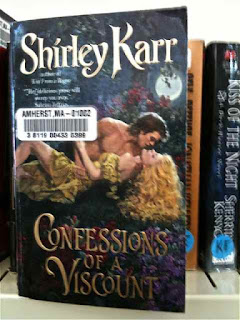
Confessions of a Viscount
Your tax dollars at work.

Friday, August 12, 2011

Walking the Walk and Tweeting the Talk


According to a new survey released this week, web search engines and email are the most popular forms of digital media among the US adult population: some 92 percent of us use them, 60 percent of us, daily. Nearly half of us use social networking sites (SNS), such as Facebook. What is interesting is not just the increase in overall use of SNS (nearly doubled from 2008 to 2010), but also the changing demographic: both older and more gender-balanced. The average age of the social network site user has risen from 33 to 38, with half over 35. And, at 56 percent, women's participation now slightly outnumbers that of men. However, only 13 percent of us are on Twitter (though world-wide, we are 200-million strong).

Is Twitter, as so many acquaintances dismissively say, a faddish and foolish exercise in narcissism—a sort of metaphorical modern mashup of the twentieth-century "pet rock" and vanity license plate—or, as others maintain, a valuable social, intellectual, and marketing tool?  As an inveterate tweeter, I of course incline toward the latter opinion. The usage statistic alone, absent more granular data, could support either view. If it's a fad, though, it's certainly restricted to a relatively small population, but which: the proverbial "early adapters"? (if so, what is the profile?) gen-Xers? And just how do they use it? One of my "tweeps" (to you non-users: a Twitter friend, someone I "follow" or who "follows" me) perfectly summarized the competing views last month in a nice little blogpost entitled, "How to Use Twitter (and Why It’s Not a Waste of Time." There, she lovingly and originally characterized Twitter as: "the semi-colon of social media – people have an idea of your existence but many have not fully grasped your usefulness and beauty."

We are only beginning to study the significance of new social media, and Twitter is arguably the least-studied and least-understood among them. To be sure, there have been some rather silly pieces about use of Twitter in the classroom (spare me, please; I'd be happy if my students used spellcheck intelligently), but relatively few rigorous studies of its real value in the academic and cultural sphere, proper. I hope to address that question eventually. In the meantime, I instead wanted to do something much more modest, namely: share one example of how my colleagues and I recently employed Twitter for both academic and social purposes.

As I mentioned in my brief post on the SHARP conference on the book in art and science, social media are coming to play an increasingly important role in our gatherings, and not just in a trivial or recreational way. Last year, in Helsinki, we made full use of a variety of media. For example, we live-streamed some of the main events, such as keynotes and plenaries. Most novel, however, was our use of Twitter. Several of us began to tweet coverage of the events, simply because we tweet all the time. Several people who could not attend said that this coverage not only allowed them to experience the events from a distance, but even inspired them to join the organization. We could not have hoped for a more encouraging result.

This year, as an experiment, we decided to make tweeting an official activity. Many officers on the Executive Council—the President, Vice President, Treasurer ("That, uh, that, that would be me," as Bob Newhart used to say), Recording Secretary, and Membership Secretary—are already individually active (to varying degrees) on Twitter, and there is in addition a general SHARP Twitter account as well as a special one for this conference. "Official" here meant: explicitly endorsed and encouraged from above. In order to lend some material incentive to that moral exhortation, we even offered a prize—in the form of copies of the winner of the annual Book Award—to the ten top tweeters. (Among other things, that meant putting our money where our mouth was—and your Treasurer, I can assure you, does not disburse your funds lightly). We generated over 2000 tweets, archived here.

There were many pleasures, chief among them, the rewarding feeling of belonging to a community within a community (which is to say, as far as I was concerned, a more intimate alliance rather than any form of snobbery), and the excitement at the prospect of finally meeting at the conference, or at a separate "tweet-up" after hours, face to face, people whom one knew only by their usernames, and via 140-character snippets of conversation.

In the course of our (real-life as well as virtual) conversations, SHARP Board member George Williams, by day a professor of English at the University of South Carolina Upstate, who at night dons the cape and tights of heroic editor of the "ProfHacker" blog on at the Chronicle of Higher Education, asked the more active tweeters to write up brief reflections on their use of this social networking tool at the conference for his column.

Here's the beginning of my contribution:
To tweet or not to tweet? If I do not tweet for myself, who will tweet for me? If I tweet only for myself, what am I? Twitter, as one of my non-SHARP “tweeps” says, is the most misunderstood of social media. To wary outsiders, for whom it represents an exercise in egotism, I gently explain that it all depends on what you are looking for and whom you choose to follow. In the 4 years I’ve been on Twitter, it has become one of my most valuable research and networking tools. Frankly, I am much more interested in what total strangers on Twitter are reading than what my Facebook friends had for lunch or their kids did at the birthday party. . . .
George's introduction and the rest of the individual contributions can be found here.

What do you think? Comments welcome.