Events

Showing posts with label Libraries. Show all posts

Monday, September 1, 2014

The Un-Bomb (1): Former Baroque Armoury Turned Library

Ever since Isaiah had a vision of men beating their swords into ploughshares, it has been pleasant to imagine or witness other examples of the tools or symbols of war being converted into those of peace. I've posted a few examples over on the Tumblr.


Full series of images plus commentary: Books, Not Bombs

Friday, November 30, 2012

New Leaders at Hampshire College Library: Library Director Jennifer Gunter King and Archivist Jimi Jones


Good news really deserves full and proper coverage, but since I am (for a variety of reasons) unable to give it that at the moment, I'll take solace in the fact that it also speaks for itself:

In the interval since my first mention of our library search, Hampshire College has made not one, but two outstanding hires, the first for the position of Director of the Library, the second for College Archivist. I was a member of the search committee for the former and attended the candidate talks and offered feedback for the latter. As it happens, I was personally acquainted with the successful candidate in the former and was familiar with the work of the latter. I could not be happier.


Welcome, Jennifer Gunter King and Jimi Jones!

Our new Library Director is Jennifer Gunter King, whom I have known for five years, since we worked together on the "Bookmarks" events of Museums 10, the consortium of Pioneer Valley Museums. Arranging book-related exhibitions and programs engaging institutions from the Emily Dickinson Museum (obvious) and Five College art museums (logical enough) to the Amherst College geological museum (now, that was a tough one) was no mean trick, and it is no understatement to say that Jennifer's energy and creativity were a driving force behind the series, its intellectual conception, and its success. (program site here; I posted a few brief descriptive reports on the first half of the program here; Roger Mummert of the New York Times wrote about the exhibition and the general book culture of the area: "In the Valley of the Literate.")

Jennifer, until now head of Archives and Special Collections at Mount Holyoke College, has many talents. Trained to work in traditional rare print and manuscript sources, she is also passionately committed to doing the work of the present using the tools of the present, and geared to the distinctive needs of Hampshire College. For example, given that we do not have traditional "special collections" involving internationally famous rarities, and rather, documents mostly associated with the personae or general mission and values of the young college, she sees the need to highlight student and faculty work, to digitize and publicize our current cultural production.

I'll let her explain her approach herself in this profile, published at the time of her hiring in March. Among other things, it said, "At Hampshire, she believes it is essential to showcase the intellectual output of the Hampshire community past and present. Because of the preponderance of work done in new media, King wants to make sure that, from an archival and research perspective, work isn’t lost due to a lack of ability to preserve and showcase those materials."

This philosophy meshes perfectly with that of our new archivist, Jimi Jones. He comes to us fresh from a prestigious position at the Library of Congress, with equally impressive credentials and an equal commitment to both cutting-edge practices and the distinctive mission of the College. Although I had not met Jimi before his campus visit, I was familiar with his regular blog posts on "The Signal," the digital preservation blog of the Library of Congress. What impressed me was not just his expertise in these specialized (though today becoming the norm) areas, but also his historical perspective and breadth of vision. Like Jennifer, he understands the role of digital media.

Like Jennifer, he also has multiple talents and varied interests, extending, for example, to art, and in particular, the book arts, with which he was involved at the University of Utah. Book arts, perhaps because students have a new appreciation for the physical and the tangible in an increasingly "virtual" age, have become very popular since we founded the Center for the Book here at the end of the last century (sorry, can't help myself: just like to use that phrase). The two worlds came together recently just around the time of Jimi's arrival with our very successful "Pulp to Pixels" program and exhibit (blog here), funded by a Five College Mellon grant for digital humanities. Jimi hit the ground running, and his energy, approach, and talents can be appreciated from this report, which he posted on our Hampshire Media Tumblr.

Not only do these hires bring to us two talented leaders of their respective departments or domains. They will also be a wonderful stimulus to all aspects of our Center for the Book, which understands "the history of the book" as the study of the technologized word, thus embracing the entire sweep of development from the origins of writing to today's "new" media.

Obviously, great hires such as these are good for the College in a direct and practical sense. More generally and perhaps more important, though, the decision of these two highly qualified professionals to come here when they could be highly competitive and sought-after candidates anywhere, is a real vote of confidence for the accomplishments and prospects of the institution. These days, Hampshire College, under the leadership of new President Jonathan Lash, is feeling a new sense of energy and collective purpose as it continues to fulfill its mission of preparing students to learn and live in an ever more complex world in which the liberal arts must retain their value even as the nature of knowledge and information are changing at an unprecedented pace.

Monday, April 2, 2012

Meet New Hampshire College Library Director Jennifer Gunter King


From the Hamphsire College web site:

There are clichés that tend to define the idea of a library: Unbreachable quiet that stretches through long, dark expanses of book stacks. The smell of old paper and dried ink. Quiet corners and carrels where solitary work plods slowly along.

Jennifer Gunter King, Hampshire College’s new director of the Harold F. Johnson Library, isn’t a huge fan of that vision. 

Jennifer Gunter King
“The library today is in the process of evolving from a repository into a center that functions as a hub and gateway to all sorts of resources,” she said. “The library director position in a place like Hampshire, which already embraces a philosophy of pushing the envelope, is well poised to figure out what the library of today and tomorrow looks like.”

To King, that means looking beyond the paper foundation most libraries are built on. With master’s degrees in library science and history from the University of Maryland, College Park, King understands that the fundamental shift from paper to digital means restructuring the library to be as robust virtually as it is physically.
[read the rest]

Sunday, August 14, 2011

Gotta Love Those Romance Titles (or: the price of freedom is eternal kitsch)


The American politicians and publishers who, in the title of John Hench's prize-winning book, sought to use "Books as Weapons" in the war against fascism, thought they were making the world free for democracy. Of course, they were also making the world free for free markets, and thereby, not just for Hemingway, Steinbeck, Saroyan, and the other authors whom they held up as models of civic engagement and cultural achievement, but also for all sorts of literary trash.

To put it another way: the price of liberty is eternal kitsch. Of course, that's the price of "totalitarianism," too, though in different ways and for different reasons. While I was in Prague this spring, I saw a massive and fascinating exhibition on the stifling of modernism and the avant-garde, first, by the Nazis, and then by the communists. 

For many of us, the romance novel epitomizes American literary kitsch. To be sure, the genre and its readership have become the subject of scholarly study: one thinks first and foremost of the pioneering work of Janice Radway, who provocatively argued against the dominant condescension toward both.

Sorry, I digressed: I was starting to risk venturing into the serious, which is not at all my purpose here.

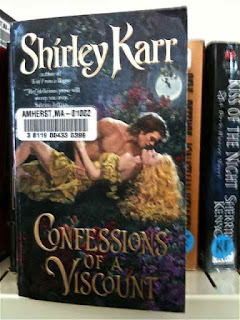
Anyway, when it comes to the romance novel, many of just appreciate the lame titles and cheesy cover art. The titles may not be as distinctive and clever as those of classic country and western songs, but like them, they do adhere to certain conventions and constitute a sort of subgenre in their own right. In this case, though, one suspects that the humor is accidental, or at any rate, if implicitly part of the publishers' intent, not uppermost in the minds of their consumers.

This spring, as the Amherst Historical Commission prepared to put forward a request for Community Preservation Act funds for the restoration of paintings hanging in the Jones Library (still need to post about that), I took a stroll through the building to re-familiarize myself with the location of each work of art.

Lo and behold, I came across one of the canvases— Paul Dominique's late 19th-century "Arabs Mounted in Battle"—hanging over: the romance collection.


To me, it actually seemed entirely appropriate. Whereas some might see a glaring contrast between this "high" work of art—after all, it's an oil painting more than a hundred years old, in an elaborate gilded frame (what more need one know?)—and the genre literature of mass cultural production below, I see but variations on a theme.

To be sure, the painting is "historically significant" (otherwise we could not fund its preservation), and reasonably competent, but it is a typical piece of orientalism, depicting the exotic "otherness" of Arab culture for the delight of the western viewer. Unlike a book published in a pressrun of tens or hundreds of thousands of copies, Dominique's painting is a cultural product that exists in but one exemplar, and yet for all that, it is interchangeable with dozens if not hundreds of others. In its own way, it is every bit as conventional as the romance novel—and conventional ideals, representations, and sentiments are the hallmarks of kitsch.

And of course the connection doesn't end there. The Arab male has long functioned as a figure combining danger and allure. One need but think of Valentino and the vogue of "the sheik" theme, derived from the novel of the same name by E. M. Hull (whose real name was not the same: Edith Maude Winstanely). In fact, as the publishers of the new edition remind us, "The Sheik is recognized as the immediate precursor to the modern romance novel." Apparently, the theme has even been making something of a comeback. Oy (as they say). [this ¶ was accidentally omitted from the original upload.]

A classic debate in library philosophy has been whether to collect comprehensively or selectively: as much as possible, or only "the best": what Matthew Battles called the distinction between the "universal" and "Parnassan" ideals of the library. On the local level, this most often gets translated into debates about whether to purchase popular fiction, controversial political works, and the like. Romance novels are among the most contentious genres. The limited evidence suggests that most public libraries do have fairly extensive holdings of romances, though precise patterns of acquisition and funding are less clear. Most libraries have a romance novel collection because there is public demand for it and they serve the public; and there's nothing wrong with that.

Damn. I keep getting serious. Must. Stop. Now.

So, back to those romance titles and covers. One of my favorite "tweeps" and library bloggers, Rita Meade, a.k.a. Screwy Decimal (here, the blog; here, the Twitter account; further: 1, 2, 3) has made a minor art of chronicling the inanity and inadvertent humor of romance titles and romance novel culture—to which she adds her own very intentional humor under the rubric, "Romance Title of the Day," e.g.:
• 'Sex in the Middle Ages.' Well, I hope they practiced serf sex.

 • 'His Virgin Secretary.' Well, I guess it's something to put on the ol' resume.

• 'His Pregnancy Bargain.' I love when a man puts the "us" in uterus
I promised Rita I'd share some of our local examples.

At any rate, without further ado, here's my modest contribution. My favorite is One Fine Cowboy: He's got a way with horses. . . and with women . . . . Feel free to supply your own commentary. The possibilities are almost endless.

The Dangerous Baron Leigh

One Fine Cowboy

A Pregnant Proposal

Confessions of a Viscount
Your tax dollars at work.

Friday, August 12, 2011

New Director at the Jones Library

From: To Find the Principles


 On Tuesday evening (August 9), the Trustees of the Jones Library selected Sharon Sharry, of the Greenfield Library to become the new Director of our public library.

I've been covering the search over on the main and history blog site, simply because that's where most other Jones Library coverage has been, given that it has involved primarily historic preservation and local politics.

It's an exciting and welcome development: staff and residents are energized and inspired, and one can only wish Ms. Sharry all possible luck and success. She can lead the Jones knowing that the town is behind her.

Here are links to the main recent posts:

• Here Today, Gone Tomorrow
• Update: New Director at the Jones Library (and some advice on new media needs)
• Initial report on the choice of Sharon Sharry as Director
• Report on candidate presentation by Sharon Sharry
• Report on candidate presentation by Christopher Lindquist


Tuesday, October 26, 2010

"The Big (Awful) Picture--2010 | Losing Libraries

How bad is the state of public libraries in Massachusetts? (=budget cuts, branch closures, layoffs, reduced hours, etc.)

Map it.

(h.t.: MM)

Friday, October 8, 2010

Breaking News: Jones Library Director Bonnie Isman Retiring

Amherst Town Manager John Musante this afternoon informed the Select Board that longtime Jones Library Director Bonnie Isman—whose strained relations with some members of her board of trustees had recently been in the news—announced her retirement as of December 10.

No details yet.